Outline First or Draft First? Two Ways to Begin with AI
Compare outline-first and draft-first AI writing to keep paragraph order under your control and choose a starting method that fits the work.
Outline-first or draft-first AI writing comes down to one choice: do you want to arrange the argument before seeing prose, or discover possible arrangements by inspecting a rough draft? The answer depends less on how much you know about the subject than on what you need the first version to help you decide.
What does the first draft need to help you decide?
Use outline-first when your main question is how to express an order you have already chosen. Use draft-first when your main question is what order might make the material clearer. That distinction keeps AI in a supporting role: it can supply provisional wording or expose possible arrangements, but you decide what the piece means.
Think of the methods as different ways to inspect an argument. An outline lets you review the logic without polished paragraphs getting in the way. A rough draft lets you see how ideas sound beside one another, but its fluent transitions can make an awkward sequence seem more settled than it is.
When should you outline first?
Outline first when the reader needs to encounter ideas in a particular order, such as a set of instructions, a case for a decision, or an explanation that depends on earlier context. You do not need a detailed plan. A few section jobs are enough to give you something concrete to compare with the generated prose.
Try writing each heading as an action the section must perform. “Show why the first option fails” is easier to assess than “Option one.” If the headings describe the work rather than merely name subjects, you can spot paragraphs that do not belong.
Before drafting, check the structure and decide what to do based on what you see:
- Check whether you can state the central claim in one sentence; if you can, use it to judge each section, but if you cannot, pause drafting and clarify the claim.
- Check whether every heading has a distinct job; if two headings do the same work, combine or differentiate them, but if their jobs are distinct, keep both.
- Check whether the order gives readers needed context before they need it; if it does, retain the sequence, but if a later section explains an earlier term, move that explanation forward.
- Check whether a section depends on information you do not have; if it does, mark the gap for follow-up, but if the information is available, add it to your working notes.
- Check whether an example clarifies a difficult point; if it does, reserve a place for it, but if it repeats an explanation, cut the example or give it a different job.
- Check whether a heading promises more than the piece can support; if it does, narrow the heading, but if the evidence and scope fit, keep the promise.
Then draft against the plan and compare the result with it. A paragraph that strays from its section may reveal a useful point, but decide whether to move it, make room for it, or remove it. Do not keep it just because it reads smoothly.
When is draft first more useful?
Draft first when your material is clear but its relationships are not. A rough version can make a contrast, recurring idea, or missing transition easier to notice. Treat the sequence as a proposal, not as an editorial decision already made.
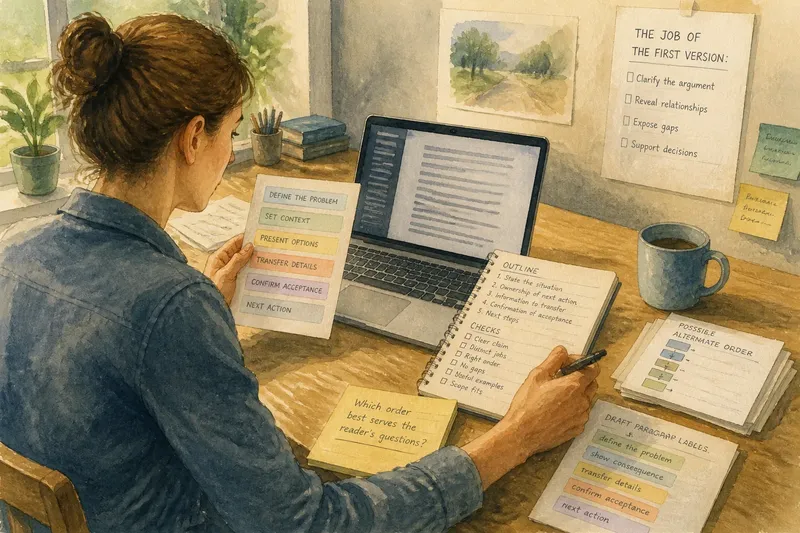
After reading, give each paragraph a short label such as “define the problem,” “show a consequence,” or “offer a qualification.” Put the labels in a separate document or in comments, then read only those labels in order. If the sequence feels confusing without the prose, revise the arrangement before polishing sentences.
Keep the first request small enough to review closely. Ask for a short provisional passage with clear paragraph breaks, not a finished piece. Then check whether the paragraphs do different work, whether each transition follows from the previous idea, and whether the draft introduces claims that need support.
How can you compare two possible arrangements?
When neither method is an obvious fit, compare structures rather than asking which draft sounds more polished. List the main ideas on separate lines. Arrange them in one order that follows the reader’s questions and another that follows the logic of your argument. Read both sequences without drafting full paragraphs.
Choose the order that makes the intended point easiest to follow. If each order solves a different problem, keep the stronger one as the main structure and move the other insight into a section or transition. You do not have to accept an AI-proposed sequence merely because it is coherent.
Say you are writing an invented note for a team that needs to decide how to handle a delayed project handoff. Your starting material is three points: who owns the next action, what information must accompany it, and how the receiving person confirms acceptance. You ask an AI tool for a rough version, then label its paragraphs. If it explains confirmation before describing the information to transfer, move that paragraph after the transfer details. The resulting order lets readers understand what is being handed over before they learn how acceptance is recorded.
Which outline-first or draft-first questions come up most?
Can I switch methods while drafting?
Yes. You might sketch the argument first, draft a difficult section, then revise the structure when the section exposes a missing connection. Record the change in your outline so the rest of the piece follows the decision.
What should I do if the draft changes my structure?
Identify what the new order improves and what it makes harder to understand. Keep the change only if it serves the piece’s purpose, and revise the headings or transitions yourself to reflect that choice.
What if I cannot tell whether a paragraph belongs?
Write its job in a short phrase, then ask whether that job advances the piece’s point. If not, move it to a more suitable section or remove it; if it does, clarify the connection for the reader.
Should I edit sentences before the structure?
Usually, check the sequence first. Sentence-level polish can make paragraphs feel complete before you have decided whether they belong in that order.
How do you keep the final structure yours?
Save the outline or paragraph labels beside the draft. As you revise, make each structural change deliberately: name what it improves, then check that the surrounding sections still connect. This leaves you with a record of the reasoning, not just a sequence inherited from generated prose.
For outline-first or draft-first AI writing, use the method that exposes the decision you most need to make. If the order is already clear, draft within it. If the order is uncertain, use rough prose to examine possibilities, then choose and revise the structure yourself. Before keeping any claim, example, or detail, verify that it is supported by material you trust.