A Voice Checklist for Your Next AI-Assisted Draft
Use this voice checklist for an AI-assisted draft to spot borrowed phrasing, restore your natural emphasis, and decide what to revise before sharing.
You have an AI-assisted draft open, and the sentences are polished but oddly interchangeable. A voice checklist for an AI-assisted draft can help you decide whether its sound suits your role, your reader, and the relationship between you.
Focus on the choices that shape how a message lands: formality, warmth, directness, and distance. You are not trying to make every sentence resemble your casual speech. You are deciding which register you intend to use and whether the draft maintains it.
What voice does this situation call for?
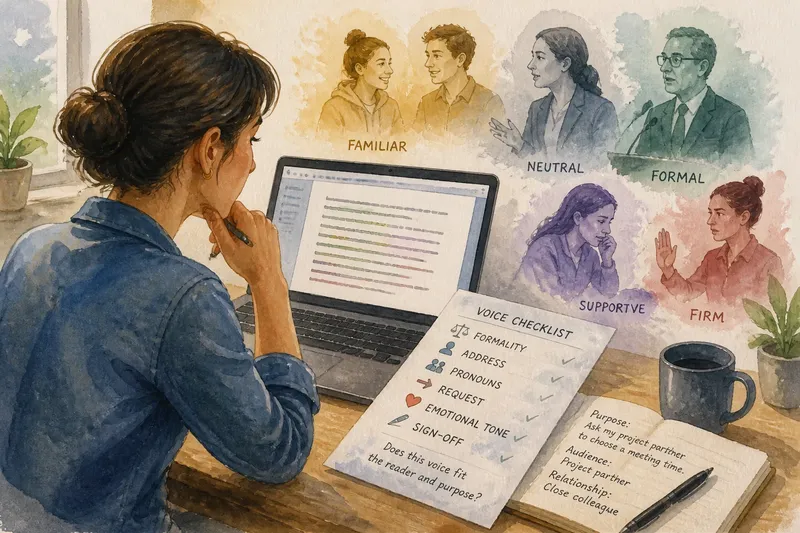
Before editing, name the audience and purpose in a sentence. “This note asks my project partner to choose a meeting time” gives you a clearer target than “Make it professional.” Then identify the relationship: close colleague, new client, public audience, or someone you are addressing in an official role.
Consider the register that fits:
- Familiar: Use direct, conversational wording for someone who knows you and expects a personal exchange. If the draft sounds like a formal announcement, then loosen the phrasing; if it becomes too casual for the subject, then keep the warmth but restore a clear boundary.
- Neutral: Use plain, courteous language when the reader does not know you well. If the draft leans on jokes or insider shorthand, then replace them with clear wording; if it feels cold, then add a brief human acknowledgment.
- Formal: Use a structured, restrained tone for official or public communication. If the draft uses chatty asides, then remove them; if it becomes stiff or evasive, then state the purpose directly.
- Supportive: Use considerate language when the reader may be under strain. If the draft sounds breezy or dismissive, then acknowledge the situation; if it overdoes sympathy, then keep the acknowledgment brief and focus on what the reader needs.
- Firm: Use explicit boundaries for a refusal, correction, or decision. If the draft buries the decision in apologies, then move it forward; if it sounds punitive, then state the limit without adding blame.
These are choices, not fixed personalities. A person can write warmly in a formal setting or firmly to a close friend. The test is whether the tone helps the reader understand the message and the relationship.
Which voice signals should you check?
Read for patterns rather than searching for a personal catchphrase. An AI draft may sound unlike you because it changes the level of formality or emotional distance, even when its vocabulary seems familiar.
- Contractions: If you normally write “I’m” and “we’ll” in this setting but the draft uses “I am” throughout, then restore contractions where they feel appropriate; if the message is formal, then keep the fuller forms where they aid clarity.
- Directness: If the draft hides a request behind several introductory sentences, then put the request closer to the top; if it sounds abrupt, then add a short reason or courteous transition.
- Warmth: If the wording feels impersonal for this relationship, then add a sincere acknowledgment; if friendly language could blur a serious boundary, then make the boundary explicit.
- Jargon: If the reader may not know a term, then spell it out or use plain language; if the term is shared shorthand, then keep it when it makes the message easier to read.
- Sentence rhythm: If every sentence has the same formal cadence, then vary the structure; if a short fragment could seem careless in this context, then make it a complete sentence.
Do not edit a phrase just because it differs from your usual habits. Ask whether it sounds deliberate in this situation. A new register can be appropriate; an accidental change in distance or authority can confuse the reader.
How can you make a voice checklist for an AI-assisted draft?
Use this list on one pass. For each item, mark what you observe and choose the action that follows. The alternative matters: a feature that works in one setting may be wrong in another.
- Formality: Check whether the draft uses casual or official language. If it matches the audience, then keep it; if it clashes, then shift the wording toward the register the reader expects.
- Address: Check whether the draft uses the reader’s name, title, or a general greeting. If that form suits your relationship, then retain it; if it feels too familiar or distant, then change the greeting.
- Pronouns: Check whether “I,” “we,” or passive phrasing makes responsibility clear. If the right person owns the action, then keep that wording; if responsibility is obscured or wrongly assigned, then name the appropriate person or group.
- Request: Check whether the reader can identify what you want. If the action is clear, then leave it in place; if it is buried or vague, then rewrite it as a direct request.
- Emotional tone: Check whether the draft sounds warm, neutral, apologetic, or severe. If that tone fits the situation, then preserve it; if it misrepresents your intent, then adjust the acknowledgment or boundary.
- Sign-off: Check whether the closing fits the relationship and purpose. If it sounds natural for this exchange, then keep it; if it implies intimacy or formality you do not intend, then choose a more suitable closing.
What should you ask about tone and audience?
Should I read the draft aloud?
Read it aloud when the rhythm or degree of formality is hard to judge on screen. If you stumble or hear a phrase you would not use with this reader, then revise that passage; if it sounds natural and fits the setting, then move on.
Should I compare it with an older message?
Compare it with a message you wrote for a similar audience, not with a casual note from a different setting. If the older message reflects the tone you want here, then use it as a reference for distance and directness; if the contexts differ, then rely on the current purpose instead.
Should an AI draft sound exactly like me?
No. A formal application or public statement may call for a different register from a personal message. If the difference is deliberate and comfortable to stand behind, then keep it; if it makes you seem more intimate, certain, or authoritative than you intend, then revise it.
What if another person or policy is involved?
Check relevant workplace or organizational rules before sending writing that represents a role, shares sensitive information, or makes a commitment. If the policy leaves a real question unresolved, then ask the appropriate qualified person; if the issue is only stylistic, then edit for clarity and fit.
How do you revise tone without making the message artificial?
Change the sentence’s function before polishing its surface. Put the decision first, make the request explicit, or replace a distant expression with a straightforward acknowledgment. Avoid adding slang, jokes, or personal flourishes just to make the draft seem more individual.
Say you need to move a meeting with a colleague because a client review has changed the schedule. You want the colleague to choose between Tuesday afternoon and Wednesday morning, and you usually write to this person in a warm, direct style. The generated draft begins, “Please accept my sincere apologies for this inconvenience,” then says you are “delighted to accommodate your schedule.” You remove the elaborate apology, explain the schedule change in one sentence, and ask which of the two times works. The resulting message keeps a considerate tone while making the reason and next action clear.
When you search for a voice checklist for an AI-assisted draft, use it to decide whether the register is intentional—not to force every message into one house style. Before sending, check that the reader can recognize the relationship, understand your request, and hear the degree of warmth or firmness you mean to convey.